
Why the High Street Is Disappearing — And Why It Feels Personal
If your first instinct is a flicker of panic, you’re not alone. But here’s the truth: some of the best evenings happen exactly like this — unplanned, a little chaotic, thrown together in under an hour (or two). You don’t need a week of prep or a spotless house. You need a handful of pieces you already own and a bit of know-how. That’s really what last minute hosting ideas come down to — not perfection, just a table that feels warm the second people walk in.
After some back & forth on unavailable dates, when suddenly they say
“How about tonight?”
And although a part of you already starts visualising the night, another part of your starts to panic.
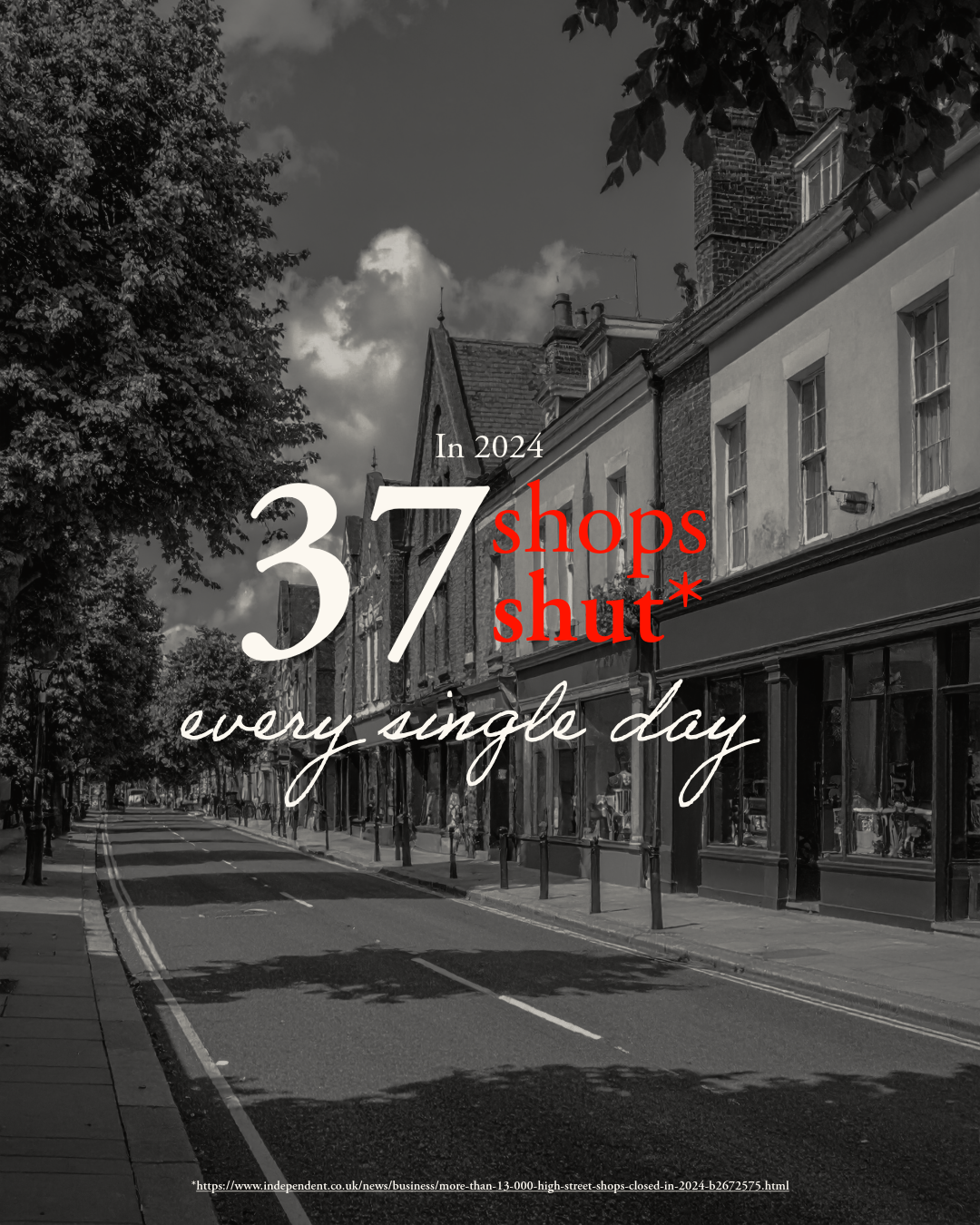
The Scale of What's Happening
The numbers are hard to ignore. More than 13,000 UK stores closed in 2024 alone — that's roughly 37 shops shutting every single day.
We've even watched household names disappear. Homebase. WH Smith from the high street. Quiz. Poundland restructuring. River Island shrinking. Yes, you read it right, River Island was given permission to close 33 stores across the UK and Ireland by the end of January 2026 as part of a restructuring plan to address rising costs and a shift to online shopping.
But beyond the numbers, there’s something else I’ve been noticing.
My Instagram feed.
It’s slowly filling with posts from indie shop owners announcing closures. Some are calm. Some are raw. Some try to stay hopeful.
But almost all of them carry the same underlying feeling —
this wasn’t how they imagined it would end.
And I don’t know what’s right or wrong in all of this.
I just know it feels deeply, deeply heartbreaking.
What's Actually Driving These Closures?
It's tempting to blame online shopping and leave it there. But the real picture is more complicated.
Rising Costs With No Safety Net
In April 2025, business rates relief for small retailers dropped from 75% to 40%. For a typical independent shop, that meant a business rates bill jumping from around £3,500 a year to over £8,600. At the same time, the National Living Wage rose to £12.21 an hour — good news for workers, but a serious pressure on small businesses already operating on thin margins.
There's no cushion for a shop run by one person. When costs jump by thousands overnight, closing is often the only option left.
Footfall That Never Came Back
Even by 2025, high street foot traffic is still 15% to 20% lower than pre-pandemic levels. People changed their habits during lockdown and, in many cases, never quite changed them back. The shops that survived Covid found themselves fighting for a customer base that had quietly drifted elsewhere.
The Invisible Competition
And yes, online shopping plays its part. But it's not just Amazon. It's the convenience of browsing at 11pm. Of not having to park. Of getting something delivered tomorrow. Against that, a small shop with one person behind the counter is working very hard indeed.
What We're Really Losing
Here's what the statistics don't capture. When a small independent gift shop closes, you lose more than somewhere to buy things.
You lose the person who remembered your name. Who said,
“Oh, I think your mum would love this — it just came in yesterday.”
You lose the chance discovery — picking up something you didn't know you needed and couldn't have found by searching for it online. You lose a place that felt like it belonged to your town, not to a head office three cities away.
The high street, at its best, was never really about retail. It was about community. About the experience of being somewhere with other people, being surprised, being helped by someone who genuinely cared whether you found the right thing.
That's what independent retailers offer. And that's what we're quietly letting slip away.
The Shift That's Already Happening
Here's what's worth knowing though: not everything is in decline.
While big chains are struggling, independent home decor gifts UK businesses — particularly online — are finding real momentum. Spending at independent homeware stores rose 29% between 2023 and 2025, even as large chains fell. Shoppers are actively seeking out authenticity. They want to know where something came from. Who made it. Why it exists.
The demand for handcrafted gifts online UK is growing precisely because people are tired of generic. Tired of the same mugs, the same scented candles, the same items you see in every shop in every town. They want something with a story — something that feels like it was made for a person, not a shelf.
That shift is real. And it's an opportunity.
How We Can Protect What's Left — Practically
This isn't about guilt. Nobody should feel bad for ordering online or shopping at a supermarket. Life is expensive and busy and complicated.
But there are small, genuinely enjoyable ways to support the independent shops and artisans who are still here. And the rewards are usually better than people expect.
Go to Your Local Weekend Market
Weekend markets — whether it's a craft fair, a farmer's market, or a local artisan pop-up — are some of the best places to find unique Indian homewares, handmade ceramics, original artwork, and gifts that actually mean something.
The gifts you find there will not be the same generic items you've seen a hundred times. You'll find makers who can tell you about their work. You'll find things you can't get anywhere else. And every purchase goes directly to a real person — not a shareholder.
Step Into the Small Shops You Walk Past
We've all done it — walked past an interesting-looking independent shop and thought "I'll pop in another time." Then never did.
Next time, go in. You don't have to buy anything. But you might find that the artisan home decor or handcrafted gifts inside are exactly what you'd been searching for online without knowing quite what you were looking for.
Choose Meaning Over Convenience When You're Gifting
When you're buying a birthday gift or a housewarming present, it's worth pausing before defaulting to a gift set from a chain store. Meaningful gifts that UK shoppers are increasingly looking for aren't found in those places anyway.
Your independent shop owners go through a lengthy process to find and bring unique, rare items for you, from both near and afar.
A hand-thrown bowl made by an independent artist in Spain. A block-printed cushion made by an artisan in India. A hand poured candle. These things carry a sense of care, of intention, of I thought about you when I found this.
Support Independent Retailers Online Too
The good news is that supporting independent retailers UK doesn't always require a Saturday afternoon and a car park. Some of the most interesting small businesses in the home and gift space operate online — allowing craftspeople and curators to reach people across the country without the punishing overhead of a physical shop.
Final Thoughts
The disappearance of the UK high street is real, and it's sad. But it isn't the end of independent retail — it's a shift in where that spirit lives.
The human touch that made small shops so special doesn't have to disappear with the shopfronts. It lives in weekend markets and in independent online brands. It lives in every handcrafted gift chosen with care instead of habit. And it lives in the decision — made by ordinary shoppers — to seek out something made by a real person rather than a factory line.
